Archive for category: 5-min. ideas

Remarkable research on kids’ ability to self-instruct

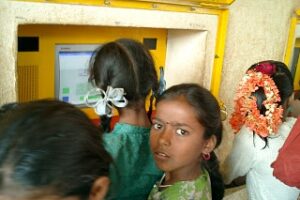
Sugata Mitra's hole-in-the-wall experiment; some children using a computer embedded into a wall.

Image: D.Salhundi, Karnatak, India

Here’s why we say you should “scatter books around the house.”

I want you to watch this exciting speech by Sugata Mitra on TED.com that illustrates the extent to which kids can teach themselves.

Through his “Hole in the Wall” project he conducted a series of experiments in 1999. He went to a slum in New Delhi, India and secured computers, hooked up to the Internet, into a wall so they could be used. And then he left.

The kids there had never used a computer before. And, the computer was completely in English—a language the kids didn’t speak or understand.

Within eight hours, an eight-year-old boy was not only surfing the Internet, but he was teaching a six-year-old friend how to browse.

The kids taught themselves how to use the PC, and the Internet—in English—and they began teaching each other.

He conducted the many more experiments which supported his theory that when they’re left alone, with the right resources, children are able to self-instruct to an incredible degree.

So how does this apply to literacy? It’s simple: Scatter books around your house. Put a book on his bed. Put a book in the bathroom. Leave a book poking out from under his dresser. Leave a book on the kitchen table.

If you leave a kid alone with a good book, he will pick up the book and start flipping through it. Soon, he will become interested in it. He will read.

Here is the speech (it gets really interesting at about 7:33).

+Continue Reading

Back to school 2010

By Julia Mohamed
It’s nearly back-to-school time! Time to go from running wild and free to becoming a studious student once again. Here are a few ideas to help make the transition as smooth as possible:
Goal Journal
Have your kids contribute to a nightly journal. Begin now, with their anticipations and goals for the upcoming year, and continue to use it as the year progresses. It will help get them into the routine of writing again, and it’ll be great to look back on it later in the year. They can do all of the writing, dictate to you, add some pictures or make it a combination of everything.
Great sites
School means reports and essays. Here are great, kid-friendly websites where kids can search for the answers to questions on just about anything.
Homework Helper
This site offers categories like “Science, History, World, Sports and exercise.” From there, kids can drill down until they find answers to questions they have on just about anything. Includes facts and information on Canada, plus a “World” category.
It’s a non-profit website and each category uses a specialist in the field to write the information and answer kids’ questions. If you can’t find what you’re looking for on the site, you can ask their experts a question and they’ll e-mail you back. They’ll also send parents links to kid-friendly websites.
Published by Pearson publishing, this site offers information and facts on lots of different subject areas, for kids K to 8. It also has an online atlas, dictionary and encyclopedia and some online games and quizzes (for instance, hangman, Star Wars quizzes, an interactive periodic table, Sudoku, how to write a book report and much more.)
Funschool Kaboose
Funschool Kaboose is a Disney site with great information, games and crafts for kids from preschool to grade 6. It also features sections for parents and educators.
Stock up on school supplies
Before heading out, prepare a list of the school supplies you need. Why not make it a scavenger hunt? Be sure to be specific when you’re writing your list: Number 2 pencils, blue and red ballpoint pens, a calculator, white erasers, a one-inch three-ring binder, etc. Refer to our article, Supermarket Scavenger Hunt for details on how to create the perfect hunt!
Reading – every night
Keep reading to your child every night. Create a reading log for your kids. A simple chart with headings including “Date,” “Title,” “Author,” “Number of Pages Read,” and “Amount of Time Spent Reading” can help keep track of how much they read. For every milestone, give your child a reward. Here’s a past GKR article on Reading Reward Charts.
If you only get a chance to do one thing from this article, check out the websites Julia found – they have a great wealth of information your kids will appreciate when they start getting into essay writing time.
Julia Mohamed is a freelance journalist.
+Continue Reading

Write your kid a letter

Have you sent your kid a letter this summer?

What a great thing to do!

When you’re bored at work – instead of re-checking your e-mail for the tenth time, or surfing, do something that will help your kid… write her a letter.

It takes, like, 10 minutes and it will be one of the most rewarding things you will do all day. Use a big, easy-to-read font like Times 18. (Resist using a cartoon or handwriting font. They may look fun, but they’re very hard to read. The easiest ones to read are serif fonts, like Times.)

You don’t have to say anything profound. Just chat, let her know what’s happening at work, tell her that you’re proud of her, ask her what she wants to do this weekend.

A letter from you will let her know that you’re thinking of her, it will give her some insight into your day and it’s a great way to get your kid reading!

When you’re finished your letter, actually mail it – don’t just bring it home. Half the excitement is going to the mailbox and getting something that’s been sent to you.

It’s also a good idea to include a self-addressed, stamped envelope that your child can use to write you back. (And if you use your work address, you’ll get something at your desk in a couple of days besides conference flyers and departmental invoices!)

Writing your kid a letter is one of the greatest ways to spend 10 minutes. For you, and for your kid.

Don’t have a kid? Write your grandchild a letter. A neighbour. A friend’s kid. Santa (don’t need a stamp for that one!). Snail-mail is fun… and it’s still pretty cheap (especially if you sneak your letter in to the company mailbox and let the firm pay for your postage).

Image: Wikimedia Commons, by Deadhoax.
+Continue Reading

Explain the exclamation mark!

This activity will boost your child’s reading in five seconds.

One of the most exciting things about reading is the exclamation mark.

The other day, I was reading a book to a couple of kids in a kindergarten class. When I got to a sentence with an exclamation mark, I stopped and pointed it out.

I told them that whenever they see one, they’re to say the sentence in a really excited voice.

We practiced the sentence in a normal voice, and an excited voice. They caught on right away.

Now when they’re reading aloud, the sentences with exclamation marks (and there are a lot of them in children’s books) are going to sound really exciting! And so they should.

This is a really fun thing to teach your child, and it will boost her out-loud reading from monotone to interesting in about five seconds. And that will make reading more exciting for her.
+Continue Reading

Reading – more fun than making your bed

I often let my son break the rules by reading.

When I tell him, “it’s time for bed,” he knows that if he grabs a book, it’ll buy him an extra half-hour or so. As long as his teeth are brushed and he’s in his jammies, I’ll extend his bedtime by a couple of chapters.

If he’s been sent up to his room to make his bed, and I discover him reading instead… the bed can wait. And as long as I know his homework will eventually get done, he can delay that by reading as well.

In fact, many rules in our house can be “gotten around” by reading. Of course, the chores have to be done eventually – but in the meantime, my son is discovering that reading is more fun than cleaning up his room.

Reading is more fun than cleaning. I break my own rules as well, staying up late reading a good book. And it’s a whole lot better than late-night TV.

+Continue Reading

"I’m bored!"

We said it to our parents – your kid says it to you.

You’ve hated hearing it in the past. But the next time he says “I’m bored!” you’re going to love it. Here’s what to do:

The next time you’re in a book store or a corner store, check out the magazines. Think about what your child loves – it may be video games, sports, cars, fashion, music, TV – this isn’t about what you want them to like, it’s about what they really do like.

Whatever it is, there is a magazine geared to it. And chances are, if they’re not used to reading a lot, this will be a revelation to them. The magazine will have the latest information on their favourite subject. Imagine how exciting that will be for your child!

Buy the magazine and hide it in your sock drawer.

So now we come to the good part. It’s raining and video-time is spent, and your child says, “I’m bored!” Go up to his room and quietly put the new magazine on his bed. Then come down and casually tell him, “There’s something on your bed.”

I guarantee you won’t see that kid for the next half-hour. Left alone with that magazine, which contains all the latest information on his favourite subject – no matter how much he hates reading, he will read it.

Well done, parent.

After he’s read the magazine, “what then?” you ask. How about a monthly subscription? Get him to fill out the subscription card, and take it to the mailbox. Or, next time leave a graphic novel on his bed. Or a comic book, or a novel. Or give him $10 and take him to Chapters to buy a new magazine. Fun! (Not boring.)

+Continue Reading

Literacy is more than reading

Have you taught your child how to read a newspaper?

I don’t mean the words themselves. I mean how a newspaper works. What a headline is. Where the author’s name is, and how to tell what’s happening in the pictures. Where does the rest of the article go off the front page? Why are there sections? And how to use the index to find the comics (very important).

This kind of information is crucial to a newspaper reader, because it helps you understand what to read, what you should skip, and what you can skim. It helps put the images in context. For instance, the same photo on the front of the Style section, and the front of the News section would have very different meanings.

Beginning readers need to know that they don’t have to (and shouldn’t) read every word of the newspaper. They need to understand what advertisements are vs. articles, what headlines and subheads are for, and how to tell which article goes with which picture.

You wouldn’t do this all at once, of course. Even a thirty-second explanation could have a huge impact. Let’s say you’re reading the paper in the morning and your child is eating her breakfast. Why not take the section that would be most interesting to her, and point out an article. Show her the headline, and the photo, and tell her what’s happening in the article.

Thirty seconds. That may be all she needs to get started – and curious. And curiosity creates amazing readers.

Newspapers are great because there’s something for everyone. You child might enjoy the sports section, the comics, the main news, or fashion. Just keep them away from any articles that could be too scary – like in the business section.

+Continue Reading

Read to your child every night

Every night? Every night.

Reading to your child could be the single most important thing you do to turn your child into a great reader. And if for some reason you “can’t” read to your child every night, forthwith are my reasons why, in fact, you can.

*He’s too tired.
(Make it a short book. Or a poem. Here’s “Hoppity,” a beautiful, lyrical poem by A. A. Milne that’s fun to read and won’t take up any time.)

*I’m too tired.
(Keep your eye on the prize – you’re creating a reader.)

*It’s boring.
(Get a book you’ll both enjoy. He may want the same book every night, and that’s fine for him but adults get bored with the same thing every night. So get Mary Poppins. There’s something interesting on every page. Plus, you can burst into song – or English accents – if you want.)

*My child won’t.
(Either you haven’t found the right book, or he’s somehow gotten the impression that it’s optional. Stay your ground. Make the book fun by using silly voices. For inspiration, check out how Robert Munsch reads to kids.)

*I can’t read.
(Get a book on CD. And by the way, how are you reading this blog? You can too read!)

*My husband puts him to bed, and he won’t read to her.
(Then read to your child during her bath. Or during snacktime. Or colouring-time.)

Read to your child every night. It’s really, really important.
+Continue Reading

Hoppity, by A. A. Milne

Hoppity by A. A. Milne

Christopher Robin goes
Hoppity, hoppity,
Hoppity, hoppity, hop.

Whenever I tell him
Politely to stop it, he
Says he can’t possibly stop.

If he stopped hopping,
He couldn’t go anywhere,
Poor little Christopher
Couldn’t go anywhere…

That’s why he always goes
Hoppity, hoppity,
Hoppity,
Hoppity,
Hop.

+Continue Reading

What you say he is, he will become

How many times have you said, “My child’s not a reader.”

If you’ve said it, he’s heard it.

The way we define our children goes a long way towards making them that way. So if we tell people our child’s not interested in reading, he’ll live up to that expectation.

Fortunately, when we speak positively about our child’s reading, he’ll internalize that message, too.

So instead of, “My daughter’s not a reader,” how about, “My son loves those Magic Treehouse books.” Or, “Last week, Martina read Amelia Bedelia at school.” Or, “I love it when I see Sam reading.”

Let those “big ears” of your child hear that you think he’s a reader – and that’s what he’ll become.

Happy Thanksgiving, everyone!

+Continue Reading