Archive for category: Crafts

Valentine’s Day literacy activities

Book heart Image: http://www.flickr.com/photos/smichael/Use Valentine’s Day as an excuse to do some fun literacy activities. (From ABC Canada.)

1. Think of words that rhyme and write a poem for a loved one.

 2. Create personalized Valentine’s Day cards and write each other loving messages. Cut out words and letters from magazines to make them extra unique.

 3. Bake Valentine’s Day cupcakes and use candy heart notes or icing to write a sweet message.

 4. Play a “Valentine’s Day edition” game of Scrabble and score double points when you spell a word about love.

 5. Show your kids you love them by reading a love-themed book together, like Clifford’s Valentine’s Day.

6. Research the meaning behind Valentine’s Day.

Holidays provide a great opportunity to incorporate creativity and imagination with fun literacy-related activities to be enjoyed individually or as a family. Benefit from literacy by spending 15 minutes a day reading, writing, playing a game or following a recipe.

+Continue Reading

Take 30 seconds for literacy this holiday

Think about literacy.

Take 30 seconds during the holidays – today - to reflect on how you can help your child become a better reader, enjoy books more and have greater access to books.

Just taking the time to focus on literacy will bring your child one step closer to enjoying reading more.

Here are some ideas to help you answer the question:

“How can I help my child enjoy reading more?”

* Extend your child’s bedtime – as long as he’s reading, he can stay up a bit later.

* Take your child to the library.

* Buy a great book and put it on your child’s pillow for her to discover tonight.

* Buy yourself a good book. When kids see their parents reading, they’re more likely to read themselves. (Have you read Andre Agassi’s new biography Open? Even if you don’t like sports, biographies or Andre Agassi – you will enjoy this great, fast and engaging read.)

* Read with your child tonight, even if he’s already reading by himself.

* Buy books at Goodwill or another second-hand store.

* Rent your child the movie of a famous book. Buy the book too.

* Suggest that the grandparents purchase a magazine subscription for your child.

* Buy your child a booklight. Let him use it tonight after lights-out.

* Get your son a fact-based book like the Guinness Book of Records or one with lots of adventure like Percy Jackson and the Lightning Thief (the graphic novel has just come out).

* Get your daughter a book with lots of great characters and developed relationships, or one with a wonderful, empowered heroine like Eloise.

* Don’t ever give up. Every second you spend with your child on reading is quality time and an investment in his future.

Image: Wikimedia Commons, by this author.

+Continue Reading

Mother-Son bookclub part II

Our mother-son book club met again this week.

It’s a great example of parents taking their children’s literacy into their own hands. And anyone can do it – you can do it.

The boys drew, read, wrote, ate,
chatted, answered quiz questions
and had an amazing time.

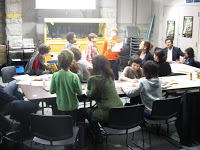
Once again, the evening was total chaos… and I wouldn’t have changed a thing. There were boys writing, boys reading, boys drawing maps of faerie sightings in their neighbourhood, boys eating cupcakes, boys talking (in very loud voices—ok, shouting) about books, boys presenting at the front of the room, boys running around and overall, boys enjoying and sharing their experiences with books.

There were about half a dozen moms wondering what the heck was going on. (The one dad remained very calm, taking it all in stride.) The moms all had the same expression on our faces. It said: “This is chaos!”

Yes, it was chaos. It was wonderful chaos.

It was the way boys often need to learn, to connect, to delve into books, to share. Touching things and doing things and running around occasionally and eating snacks—while they were learning.

Every boy there walked away knowing that for a month, while they were living in “The Spiderwick” world—there were a dozen other boys in exactly the same world. And that’s the whole point of the bookclub.

Our itinerary:
Amongst the chaos, quite a lot was accomplished.

The book this month was The Spiderwick Chronicles (Book I), about three siblings who move into an old house and discover a secret world of faeries and goblins.

Two families hosted; their boys created a quiz about the book and its characters. They called out questions and the audience members answered.

They also gave out hand-outs: one asked kids to draw a map of their neighbourhood, showing where faeries and goblins could be found; another had kids draw their own “field guide” book cover; another gave the first three lines of a poem and had the child create the final line; still another taught “deductive reasoning.” So there was something at both ends of the spectrum, for kids who prefer drawing and kids who prefer writing.

Joulie handed out our special shrinky-dink I.D. badges that we’d created last month. They looked fantastic and the kids were excited to see their creations turn out so well.

And then Joulie created special I.D. cards for each child, which she’s brought home to laminate. (Yes, Joulie is our neighbourhood supermom who not only has a shrinky-dink machine, but apparently a laminator as well!) Each card has a photo of the child, which Joulie must have taken last month, wearing a fake moustache. I completely missed that she did that – when does she do these things?!

We read out a couple of the stories the kids started last month. Remember the envelopes, on which each child wrote the beginning of a story – we each took one home to continue the story. They were handed out yet again, for the kids to develop the story a bit further at home.

There was a lot going on, all the time. The boys could draw or read or write or eat or answer trivia questions—sometimes all at once. It was so great, I can’t even tell you.

You’ve got to start up a kids’ book club in your neighbourhood. (Just don’t ask to borrow Joulie, ’cause you can’t have her.)

Next month:

Our book selection for next month is Big Nate: In a Class by Himself.

In December, we’re doing The Red Pyramid, which is a really big book so we’re giving two months’ notice. We’re also suggesting that parents check the audio version of the book out of the library (you can get the CDs or download an MP3) because the book will be a bit too ambitious for some kids to read.

+Continue Reading

Mother-Son book club

My friend Joulie is a supermom.

That needs to be said right off the bat. There is no way to live up to the things that Joulie does with her kids. And for the kids at the school. And for the neighbourhood kids.

Luckily, I don’t have to be as good as Joulie – I can just wait until she organizes something, and jump right in. (And now thanks to this post you can, too.)

Her latest venture is a mother-son book club. It’s a fantastic way to get kids reading. It’s also a boy-celebration of books and of reading.

I wasn’t sure what to expect from a mother-son book club. The book clubs I’ve been to have been calm, thoughtful, philosophical affairs (with wine). This was not that kind of book club.


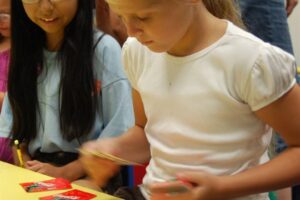
About a dozen boys and their moms (and one dad) gathered in a room in our local library. Each boy was given a T-shirt with a Star Wars character on it with the caption, “Reading is strong in this one.” Their first task was to colour the shirt with fabric markers.
I love this shot of Joulie as she tries to say something over the
din of boys drawing, and eating, and laughing – in short,
celebrating books in a way that only boys can!
At the same time, a boy was asked to come to the front and talk about his favourite book. My son gave a heartfelt speech about Rick Riordan’s “The Red Pyramid.”

After that came the trivia questions about Diary of A Wimpy Kid. “What was the main character’s father’s name?” Hands go up. “Frank!” Correct.
Fun, fun, fun.
Then, each boy and each mom made a shrinkey-dink name tag, which Joulie (of course supermom has a shrinkey-dink machine, it’s one of the many things we love about her) will shrink down for next month’s club meeting.


While we drew our name tags, another boy presented his book and more trivia questions were read out. We kept going that way until each boy had presented. The list of books presented was varied and interesting: How to Train Your Dragon; Hamish X and the Cheese Pirates; The Hardy Boys; and Percy Jackson and the Lightening Thief, among others.


While the presentations were being made, some kids were listening attentively. Some were eating cupcakes. Some were drawing. Some were wandering around, listening but moving. That’s boys! A boy book club is not going to be about perfect silence, waiting turns, putting hands up. No, a boy book club is about doing, and calling out, and giggling, and moving around, and challenging each other. And that’s perfectly fine.

Our boy book club had everything that boys like – including poop jokes, and stories that end with “and then he died,” and swords and questions and laughter and physicality.

It was by far the noisiest book club meeting I’ve ever been to. And probably the most fun.

After the presentations and name tags and cupcakes and t-shirts, Joulie handed each child and each parent an 8×10 envelope. She instructed us to write the beginning of a story on one side of the envelope. Why an envelope? Why not? Next month we’ll use wood to write on, she said, or cloth or whatever else is an interesting medium for writing.

After everyone had started their story, Joulie shuffled them and everyone took someone else’s home. Our “homework assignment” is to continue the person’s story on the other side of the envelope.

Then each child submitted the title of a book they would like us all to read for next month. We chose one by random draw: The Spiderwick Chronicles, Book I. Next month we’ll all have read the book and Max’s mom will be the one to come up with the trivia questions and to bring the snacks. Joulie’s going to supply another craft, because she’s amazing at it.

The first meeting of our mother-son (and one father-son) book club was a noisy, lively, celebratory, exciting… success! We all gave Joulie a passionate round of applause and a big hug.

This book club is going to be the start of something big for our kids.

+Continue Reading

Numeracy activities

A few posts ago, I listed some great literacy activities from our school board. Here are some numeracy activities to get kids doing math (same source, TDSB).

Again, I’ve put in bold the ones I think are particularly interesting.

  • Estimate speed/distance/time relationships while travelling with your family. What was the average speed of the last trip you took?
  • Examine maps with your child. Estimate distances. Find locations.
  • Make a favourite recipe together.
  • Log and graph sports scores over time. Find trends.
  • Log and then graph daily temperatures over a one-week period with your family. (Make sure you take the temperature at the same time each day.)
  • Estimate quantities and volumes during activities like gardening or planning food for a trip.
  • Track three different stocks and see how they do in one month.
  • Do mental calculations such as estimating grocery or restaurant bills.
  • Pay cash for a purchase at the register. Check the correct change.
  • Calculate how long it will take to save for a certain item your family would like to buy using your money from a part-time job or your allowance.
  • Calculate a bat/run average for a specific baseball player.
  • Make a weekly schedule with your family. Make time estimations for different activities.
  • Read signs with your family while driving. Specifically look for advertising that has a math concept embedded in it. Talk about it.
  • Explain how to calculate the tip at a restaurant. Do the calculation together.
  • Open a bank account. Many youth accounts have brochures that explain interest rates. Read the literature together and decide which type of account will earn the best rates, minimize your transaction costs and meet your minimum balance plans.
  • Look at sports statistics. Have a discussion about an interesting trend.
  • Go grocery shopping together. Compare prices. Estimate price per kilogram. Which is the better price?
  • Talk about items on sale. Do some Internet research to find out whether other vendors have similar products costing more or less.
  • Talk about lotteries. Examine the odds.
  • Talk about how a credit card works. Look at a statement together.
  • Look at your electricity, gas or water bill. Which utility costs your family the most?
  • Look at charts and graphs that appear in newspapers or magazines you receive. Find one that has information that interests your family. Talk about the chart or graph.
  • Examine different cell phone packages. Which is the best value for your calling pattern and payment preferences?

Source: Toronto District School Board, TDSB.

+Continue Reading

Get involved in your child’s school

Enrich your child’s learning, help your teacher, get involved.

I despair when parents complain that their kids aren’t getting what they need from their school.

I despair, not because the children aren’t getting what they need from their school, but because we parents have been conditioned to accept those terms lying down. And I strongly believe that if your child is not getting what he needs from school, you can change things.

We parents need to recognize our power. We need to ignore the “stop” signs that have been put up around us—Stop! You can’t participate in school. Stop! You we can’t go into the classroom. Stop! You can’t change the curriculum.

School is not some sacrosanct chamber. It’s where our children spend the vast majority of their time during the day. School is where our children are living their lives.

And if they’re not getting what they need from school, we can change that. As parents, we need to change that. We need to add stuff, we need to get the teachers to add stuff, we need to change stuff.

We can raise money for great books if that’s what’s needed—or just make a donation to the classroom of appropriate books (with input from the teacher, of course). We can find interesting programs that are being offered and get them incorporated into our school’s curriculum. At our school, for instance, the parent council funded a chess program so now all of our kids, from grades 1 to 6, get instruction in chess once a week.

We can talk to the teacher and the principal to find out how we can help. Taking a look at our own skill set is a good place to start. That’s how I arrived at the idea to do a weekly current events session in my child’s class. I’m a journalist and I love the news, so I simply asked the teacher if he’d be interested in my bringing newspapers to the kids once a week.

How about buying a few sets of Boggle or Scrabble and introducing your child’s class to a weekly game that gets them thinking and spelling? Or researching excellent fun learning websites on the Internet, so that when your child’s computer time comes around, the teacher has some good options to offer the kids.

Or how about introducing chess to your child’s class? Chess is actually extremely easy to play at a beginner level; once you know how each piece is allowed to move, you’ve pretty much got it. (It only gets hard at more advanced levels.) You can teach yourself how to play, buy or borrow a few sets and then – presto – you’re bringing chess to your child’s classroom once a week. And as our chess instructor will readily point out, the game teaches children how to think ahead, which is a valuable life skill.

If you can throw off the shackles of “parents should not interfere in school” and get involved, there are thousands of ways in which you can customize your child’s learning, help the teacher and enrich the school’s curriculum. And that’s a good situation for everyone.

I’m not suggesting some radical, half-cocked approach here. I’m talking about taking your ideas to the teacher or the principal and letting them know what you can offer and why it would benefit the school. Working with them as a partner. And of course, the benefit to you is that your child will then be exposed to new and extended learning. I mean, like, don’t just do stuff for other classrooms – do it for your own kid’s. It’s a win-win.

+Continue Reading

Current events

I’ve been doing current events at my son’s school.

I approached my son’s teacher a few weeks ago, and proposed a weekly, half-hour current events discussion for the grade 3 / 4 class. My son’s teacher is very cool, and progressive and totally supported the idea. He also helped to provide structure for my amateur (I’m a journalist, not a teacher) efforts.

I’ve gone in twice now, and the kids do seem to enjoy it.

It occurred to me that what I’m doing with the class can easily be done by parents (and educators) with their own kids.

The Current Events class
The first class was a review of the news from the past few days. I wanted to tell the kids about some of the major news stories that were unfolding – like the oil spill and the G20 summit that’s coming to our city this summer. And then I just picked out a bunch of interesting stories that I thought kids could relate to.

I held up each newspaper article, read the headline and then explained what the article was about. I also gave a bit of information about the various newspapers available in Canada and what they were all about. I talked to them about “how” to read a newspaper – for instance, you don’t have to read every word of an article – and how to understand headlines even though they’re often written in a very truncated way.

We talked about the G20 summit – what it is and the various ways in which it would impact the city. And the oil spill, and what BP was trying to do to stop it (including shoving golf balls into the pipe! We had a show of hands as to how many kids thought that would work.)

And then we reviewed a handful of other stories including the discovery of some new species in New Guinea, the fact that our city is missing millions of dollars in unpaid speeding ticket fines, and Robert Munsch’s revelation of his alcohol addiction (we were careful to present that in a positive light—how he had overcome adversity).

The children were very interested in the news and how it affects them. For many of them, it was an introduction to parts of the newspaper that didn’t have comics or Sudoku.

And then the teacher did something really, really smart. He took a vote on which stories the kids wanted me to follow up on the next week. That way, we could see what the kids were interested in and hone the presentation to be of the most interest.

The kids picked the G20, the oil spill and the species, which I thought was an incredibly mature list—this is some heavy stuff.

Week 2
The second week I followed up on the G20: the $1B security tab for the summit, and the many tourist attractions (including the CN Tower) that will be shut down during the talks. And I was also able to report that the golf-ball idea is going ahead – and that one of the back-up plans is to use human hair to clog the spill. Seriously. (No one in the class thinks that will work, either. Maybe BP should call us.)

And we added in a few new stories that were interesting that week: the boy in Alberta who was refused the right to wear a kilt to his graduation (his principal has since changed his mind); the million works of art that are currently in the hands of the Toronto District School Board and which may be loaned out to schools; and the fact that vending machines in our city’s recreation centres will be going healthy (the class cheered).

Reading the news is a fantastic literacy exercise. Kids are keen to know what’s going on around them, but newspapers can be daunting. Headlines are hard to read and articles generally require a lot of general and historic knowledge in order to understand them. But once an adult puts things in context, kids just jump right in.

And that’s a gigantic step towards getting kids reading.

Sorry I haven’t been blogging as much as usual – but you can see how busy I’ve been. Add our school’s FunFest and other activities to the mix, on top of my “money-making” job and it hasn’t left much time for blogging. But I hope to be back on the horse again soon.

+Continue Reading

One-Page Wonders

A fun, one-page book your child will want to read.

Here is an awesome, one-page book you make.

There are three simple steps:
1) Download the .pdf of instructions.
2) Download and print the .pdf of the book (colour).
3) Fold the book according to the instructions.

OK, a fourth step: enjoy!

There is also a video showing you many different ways of reading this beautiful one-page book.

It’s a really fun way to get kids reading.

Don’t be intimidated, it looks more complicated than it is. Once you get the hang of it, it’s really quite simple. And of course, the next step is for you and your child to make your own one-page book.
+Continue Reading

How to get mail

Getting mail is fun.

Remember when you were little, and some mail came addressed to you? It was fantastic! And of course, when kids get mail… they read it.

Here are some ways to help your child get some mail:

*You get mail when you send mail. Help your child send a letter or even a drawing to one of her friends, relatives or neighbours. (Neighbours don’t even require stamps.)

*Send him a letter yourself. Let him get it from the mailbox when it comes.

*Subscribe to a kids’ magazine. He’ll get mail every month.

*Encourage your child to write to an author or even a politician. OK, a celebrity then.

*Help your child join a club, like the Toronto Blue Jays Kids’ Club. They send regular newsletters. And tickets.

*Put in a call to gramma or grampa. They’re usually good for a letter.

*Write to Santa. He always writes back.

Actually, do you know if Santa writes back in the off-season? Me neither. I think we’ll give it a try. After all, he must be getting a bit bored around now…

+Continue Reading

Lunchbox surprise

Put a note in their lunchbox.

I like to put a little note in with my son’s lunch. Notes are great for kids who aren’t that into reading because they’re short, they’re fun, and they’re from mom. I keep my notes to the point, and very upbeat. Something like: “Hope you had a great morning. I put a treat in the outer pocket. Enjoy! I love you – Mom xoxoxo

I don’t tell him to eat his veggies, or remind him to check the lost-and-found for the mittens he lost. I want him to look forward to my little notes, and that’s good “reading reinforcement” behaviour. When what they’re reading is fun, they’ll look forward to reading.

Check out these Crayola “mini lunchbox messages” I found at a Michaels craft store. They even have a little envelope. But of course, any piece of paper will do – and don’t forget the xoxoxos.

I’ve got a call in to Crayola, to find out if you can purchase these notes online. When I hear from them, I’ll let you know. And yes, I did photograph this on top of snow. Tres Canadian, n’est-ce pas?

+Continue Reading