Archive for category: Games

Brain game: Connections

Will SmithHere’s a fun game we were playing at the dinner table recently. It’s called “Connections,” and it’s great to help with creativity and get the blood flowing to the ol’ brain cells – not just for your kids but for you, too.

You start. You name two objects that seemingly have no connection to each other. Your child has to somehow connect the two objects in a logical way.

Here’s an example:

You: An electric oven and a tree.

Your child: The electric oven is based on the wood-burning stove. Wood comes from trees.

Then, it’s your child’s turn:

Your child: Snow and Florida.

You: That’s a hard one. Um, there’s no snow in Florida?

Your childAaaaaaang! (Buzzer sound). No way - try again!

You: In Florida, they have a hockey team called the Panthers. If one of the players stops really hard on the ice, his skate blades will create some… snow!

Your child (giggling hysterically at your ineptitude at this game): Oh man, mom–you were really reaching on that one! OK, I’ll accept that answer even though it’s awful. Your turn.

And on it goes.

The great thing is that there are no rules. Together you decide what’s acceptable and what isn’t.

And the other great thing is that often it’s harder to be the person coming up with the two objects than it is to be the person connecting them.

And the other great thing is that it’s all using your brain and having a good time doing it.

And then all of you can go and rent that Will Smith movie “Six Degrees of Separation.” No, wait – don’t do that. Highly inappropriate for kids. But you can watch it again when your kid’s asleep. Great flick. And, an excuse to have Will Smith’s picture on this post. Sigh.

+Continue Reading

Fun new, brain-challenging jigsaw puzzle

Ji Ga Zo puzzleThey’ve finally come up with a new, addictive, fun and brain-saving type of jigsaw puzzle that kids will actually enjoy.

It’s difficult – if not downright impossible – to explain exactly how Ji Ga Zo works. You have to try it for yourself, and you’ll understand. (Which is why I asked Hasbro to send me one – I couldn’t figure it out from the literature and now I know why.)

Here’s what Ji Ga Zo (worst. product. name. ever.) is:

1) A puzzle that you create from your own photo.

2) A game in which you (or your kids) have to find pieces with specific icons on them and locate where they go using a grid (the “acorn” goes on A-15).

3) A game that teaches “orientation” since every piece can be fitted into the puzzle rightside-up, upside-down or sideways—and only one of those options is correct for each piece.

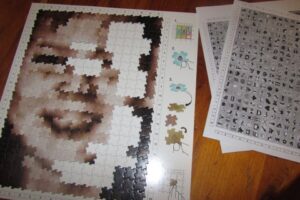
Ji Ga Zo puzzle, icon board

This is the icon board. Kids have to find the pieces that match up to these icons, and put them in place.

4) A puzzle that can be reused over and over again, with any picture you choose.

It’s a little hard to believe, isn’t it? I’ll try to explain it.

First, you choose a photo you’d like the puzzle to be. It can’t be just any photo—faces work best, and even they need to be close up and high-contrast. You put the Ji Ga Zo (how I hate that name!) in your computer and follow the very simple instructions to create an “icon board” for your specific photo.

You print out the icon board, which is a grid containing 300 one-centimetre squares. Each square contains an icon: it could be a house, a duck, an exclamation mark.

Then, you create the puzzle by finding the appropriate icons and fitting them onto your puzzle space according to the icon board… this sounds ridiculously difficult. In fact, it’s very easy—it’s just really, really hard to explain.

Ji Ga Zo (seriously, Hasbro, you couldn’t have called it Re-puzzler because it’s reusable or Griddle because it’s a puzzle with an icon grid? And these are just off the top of my head!) is very addictive and quite soothing. Harkens you back to those days when you and your mom would sit in the kitchen doing a puzzle, something we rarely take the time to do these days. And because it’s a puzzle of your child’s face, you’re more likely to want to continue making it until it’s done. And so is your kid.

The puzzle pieces are very sturdy and fit nicely together. There’s none of the wiggle-wobbling and coming apart so common to cheaper puzzles.

And you can make it easier for younger kids by sorting the puzzle pieces according to colour. Really young kids can simply help you find the pieces, which they’d find really fun. Slightly older kids can find pieces that are sorted by colour and try to find them on the grid. Older kids can do the whole thing, with or without your help.

The image itself is going to be sort of abstract. It’s not going to be a great representation of your child’s face, because it’s actually made up of shadow and light. Again, you have to see it to understand. And if you don’t have a photo you want to use, the game comes with a few including the Mona Lisa.

So here’s what I recommend. Don’t hesitate to buy Ji Ga-whatsit. It would be good for a birthday present for a party your child’s going to, or a present from gramma for your own kid. And it’s definitely got some great learning components. And it’s fun.

Once I find out from Hasbro how much it costs and where to buy it, I’ll let you know. In the meantime, I’m thinking of offering a contest to rename this thing…

Update: Hasbro got  back to me… $24.99. Name’s staying.

+Continue Reading

Valentine’s Day literacy activities

Book heart Image: http://www.flickr.com/photos/smichael/Use Valentine’s Day as an excuse to do some fun literacy activities. (From ABC Canada.)

1. Think of words that rhyme and write a poem for a loved one.

 2. Create personalized Valentine’s Day cards and write each other loving messages. Cut out words and letters from magazines to make them extra unique.

 3. Bake Valentine’s Day cupcakes and use candy heart notes or icing to write a sweet message.

 4. Play a “Valentine’s Day edition” game of Scrabble and score double points when you spell a word about love.

 5. Show your kids you love them by reading a love-themed book together, like Clifford’s Valentine’s Day.

6. Research the meaning behind Valentine’s Day.

Holidays provide a great opportunity to incorporate creativity and imagination with fun literacy-related activities to be enjoyed individually or as a family. Benefit from literacy by spending 15 minutes a day reading, writing, playing a game or following a recipe.

+Continue Reading

Play on Words – literacy action game

Cards for literacy activity

By Nancy Miller

Here’s a fun activity that can take five minutes, or roll out to 10 or 15.

The goal here is to have fun with words — and encourage your kid to get reading!

Play on Words
This activity uses three major learning styles:
• visual: they see the words.
• aural: they hear the words.
• kinesthetic: they act out the words

Here’s how to play:
1. Ask the child to say his name and what he likes to do. For instance:
“My name is Fraser. I like to swim.” (or ride my bike, or run, etc.)

2. Write down the answer in large letters.

3. Then together, pretend you’re swimming hard (lie across a chair and kick your feet while stroking with your arms; diving… make sure there’s lots of action!)

3. Read the words aloud, pointing to each word. Read the words together.

You can also extend the learning:
*Do the actions again. Then ask your child to pick out the words that go with that action.
*Keep a record of the words.
*Later you can also cut out pictures to go with the activities; this is excellent for reinforcement.

Variations
Other times, pretend:
*Animals; “My name is Fraser. I am a lion.”
*Vehicles: “My name is Fraser. I am a train.”
*Sports: “I like to play baseball.”

This will work with whatever your child’s interests are.

This activity is a shortened version of a longer learning-to-read program. If you would like more information on the program, please contact: Nancy Miller at millerneighbour@rogers.com.

+Continue Reading

Blocks With Letters On 3

Oh my, this one’s tricky!

If you have a kid who’s a real fan of puzzles, he’ll love the newest Blocks With Letters On online game – their third in the series.

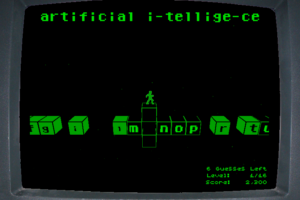
Once again, you have to figure out what word the jumbled letters spell, and then try to manipulate the blocks into the yellow squares.

Sometimes you need to flip the blocks and sometimes you need to temporarily fill a hole with one block and then slide another block over it. You always need to plan ahead, thinking about how the letters need to line up in order to spell the word.

The graphics are very silly and cool, and after every time you spell a word correctly, a little animation plays that depicts the word.

This version of the game is very tricky, so it’s not for young kids but teens who love puzzles will definitely find it intriguing. I noticed that on the BLWO games website they also have a version for the iPhone. Fun!

Here’s an earlier post about the previous two BLWO games.

+Continue Reading

Scrabble Flash (Boggle Flash)

Don’t you wish there was a board game that encourages literacy – but which your kid would actually enjoy?

Scrabble Flash goes one better… it’s also electronic, which kids love. And it’s completely portable, packing down into a little holder about the size of a small TV remote. (Which parents love.)
You get five electronic Scrabble tiles. Line them up so they’re touching at the sides (they “talk” to each other electronically this way). Turn them on, and select Game 1, 2 or 3.
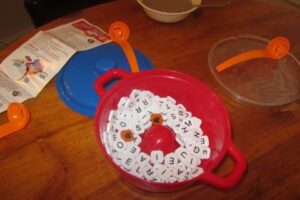
Game 1, Scrabble Flash
The five tiles each display a letter. You have to arrange them into words. For instance, if you get P-A-C-E-S you could make PACE, PACES, ACE, ACES, SEA, APE, APES and so on. You shuffle the tiles around to make as many words as you can in 60 seconds. After you make a word, the tiles flash to signify that your word is acceptable. If it’s not a word, it won’t flash and it won’t count. You can create three, four or five-letter words, although five seconds are added to the clock every time you create a five-letter word.
When the time runs out, you’re given your score (“SCR08″) and the highest score you could have gotten if you’d guessed all the possible words.
Game 2, Five-Letter Flash
Use the letters to create five-letter words. When you create a five-letter word, you’re given five new letters. You keep going until you can’t think of a word and the time runs out. It’s a great one-person game.
Game 3, Pass Flash (for two or more players)
Just like in Game 2, you have to create five-letter words. When you’ve got your word, the tiles will say NEXT and you pass them to the next player, who tries to get a five-letter word. If someone misses, they’re out and the tiles will tell you what the word was before encouraging you to pass them to the NEXT person. Last one standing is the winner.
Bring out Scrabble Flash the next time your family is waiting for their meal at a restaurant. It’s not noisy, so you won’t disturb anyone, and it’s truly portable.
In our family, Scrabble Flash has been an instant hit, not just with our son but with the adults as well. And it’s kind of addictive, actually. You want to keep challenging yourself, keep making words.
It’s extremely easy to use and the rules are simple. It’s not one of those games that has pages of arcane rules – it’s as simple as, or simpler than, Scrabble. You can play for five minutes or you can play for an hour. It’s probably best with one or two people, but theoretically you can play game 3 with a whole bunch of people.
And it will help improve kids’ literacy skills, because the more they play with letters and words, they more they will understand how they work together. For instance, every time you get an S, kids will pretty quickly figure out that they should try it at the end of the word. And then try the word without the S for a second point. Same thing when they get an E or an ES. And from there, other combinations like EA or OU.
This is a seriously good game, and I give it two thumbs up. It sells for about $30 and if you’re buying it somewhere other than Canada or the US, it’s called Boggle Flash.
Here are a couple of other reviews of Scrabble Flash.

I should mention that Hasbro gave me a “review” game of Scrabble Flash for free after I’d requested it. I mention it in case you think that my getting the game for free might skew my review. I don’t think it does, because they also sent me another game that was OK but which I didn’t think had tons of literacy potential, so I simply didn’t review it. Dat’s mah policy.

Also, the photos on this page were supplied by Hasbro. I thought they’d be better than the lousy ones I’d probably take with my point-and-shoot. But now that I see them on the page they aren’t that great, actually. Makes me feel better anyway.
+Continue Reading

Back to school 2010

By Julia Mohamed
It’s nearly back-to-school time! Time to go from running wild and free to becoming a studious student once again. Here are a few ideas to help make the transition as smooth as possible:
Goal Journal
Have your kids contribute to a nightly journal. Begin now, with their anticipations and goals for the upcoming year, and continue to use it as the year progresses. It will help get them into the routine of writing again, and it’ll be great to look back on it later in the year. They can do all of the writing, dictate to you, add some pictures or make it a combination of everything.
Great sites
School means reports and essays. Here are great, kid-friendly websites where kids can search for the answers to questions on just about anything.
Homework Helper
This site offers categories like “Science, History, World, Sports and exercise.” From there, kids can drill down until they find answers to questions they have on just about anything. Includes facts and information on Canada, plus a “World” category.
It’s a non-profit website and each category uses a specialist in the field to write the information and answer kids’ questions. If you can’t find what you’re looking for on the site, you can ask their experts a question and they’ll e-mail you back. They’ll also send parents links to kid-friendly websites.
Published by Pearson publishing, this site offers information and facts on lots of different subject areas, for kids K to 8. It also has an online atlas, dictionary and encyclopedia and some online games and quizzes (for instance, hangman, Star Wars quizzes, an interactive periodic table, Sudoku, how to write a book report and much more.)
Funschool Kaboose
Funschool Kaboose is a Disney site with great information, games and crafts for kids from preschool to grade 6. It also features sections for parents and educators.
Stock up on school supplies
Before heading out, prepare a list of the school supplies you need. Why not make it a scavenger hunt? Be sure to be specific when you’re writing your list: Number 2 pencils, blue and red ballpoint pens, a calculator, white erasers, a one-inch three-ring binder, etc. Refer to our article, Supermarket Scavenger Hunt for details on how to create the perfect hunt!
Reading – every night
Keep reading to your child every night. Create a reading log for your kids. A simple chart with headings including “Date,” “Title,” “Author,” “Number of Pages Read,” and “Amount of Time Spent Reading” can help keep track of how much they read. For every milestone, give your child a reward. Here’s a past GKR article on Reading Reward Charts.
If you only get a chance to do one thing from this article, check out the websites Julia found – they have a great wealth of information your kids will appreciate when they start getting into essay writing time.
Julia Mohamed is a freelance journalist.
+Continue Reading

Supermarket Scavenger Hunt

By Julia Mohamed

The next time you go grocery shopping, make it a more educational, enjoyable and literate experience for your kids with a Supermarket Scavenger Hunt!

1. Give each child a list of items to gather. Be as specific as possible (include a brand name, size, etc.) For instance, you might put:
□ One 18 oz jar of Kraft Crunchy peanut butter,
□ Three small green zucchinis,
□ One loaf of Dempsters 100% whole wheat bread.

It helps if your list is divided into categories, such as produce, meat, canned foods and, of course, snacks. That way, the kids will be in one specific area of the store at a time and you can keep an eye on them more easily.

For older children, throw in a few challenging items, such as ethnic foods. For instance, One jar of Red Shell Teriyaki sauce.

2. As each child brings you items, check to make sure they’ve picked out the right ones. If not, send your troops back out into the field.

3. Reward your kids with a healthy treat!

You can continue this activity when you get home. Include them when you’re making dinner by asking them to read out the ingredients in your recipe to you.

You’re going to have to go grocery shopping anyway, and you know it’s always a hassle. This great game is fun, it gives the kids a bit of freedom, and it gets them reading. A win-win! (Just do keep your eye on them, eh? I don’t want to be getting any letters from parents saying their kids were lost for days in the zucchini aisle…)

Julia Mohamed is a freelance journalist. Photo: Wikimedia Commons.

+Continue Reading

License Plate Game

Our family recently took an 11-hour car trip.

And guess what we did in the car? Played Julia’s License Plate Game.

It was great! First of all, it took our son away from his DS video game (curse you, Pokemon!).

Secondly, it did exactly what Julia said it would – it got us creating goofy sentences and thinking about words. When you have to create a phrase with the letters “FTP” you realize there are so many possibilites.

It’s funny, but the first phrase you create sticks in your mind, like “Frogs top poles” and you can’t think of any word for the letter F other than frogs.

But then someone else comes up with a completely different word for F. My husband said, “For the people.” And that created all kinds of new possibilities for us. Then we started on a bunch of “For the” sentences and that was really funny. “For the penguins.” And then we morphed that one: “Free the people.”

“Free the penguins!” (I just thought of that last one.)

Heehee. Fun game.

And no, incidentally, none of us ever thought of “that” F word. For pete’s sake, people.
Photo: Sean Mack, Wikimedia Commons.

+Continue Reading

The "Air Mail" game

My son’s friend likes to play “air mail” whenever he comes over on a playdate.

It’s a great game and I know that it works on their literacy skills because I’ve seen improvements. It involves a bit of the adult’s time, but it’s such a fun game that I indulge them whenever they ask me to play.

Here’s the game:
The kids run upstairs and hole up in their bedroom.
They each, or together, write a note to me on a piece of construction paper.
Then they run downstairs and throw the note in my general direction – and then run giggling, like criminals, back upstairs where they slam the bedroom door.

So we’ve got lots of good elements here. There’s some kind of “chase” which involves getting the note to the adult without being seen. The adult can add to the excitement by either pretending not to see the note, or suddenly flinching in the child’s direction as through he’s going to chase them.

The first note from the children will be something like:
“We want a snack!” or “Ask us a question!”

Then the adult writes a note on the other side of the paper. I usually try to get some kind of dialogue happening, like: “Ask the Oracle a mysterious question.” Last time, I tied two snack bags of jelly candy onto the note and then pitched it at their bedroom door where it made a very satisfying – and disconcerting – thump. That was the kids’ cue to gingerly open the door to see if I was still there (I wasn’t) and retrieve my note.

If you can picture it, there is a lot of silliness, giggling, whispering between the kids and slamming of doors. There’s a lot of running up and down the stairs and a lot of suspense about what the note will say, whether they’ll get caught sending or retrieving their notes and whether they’ll get a treat.

In the meantime of course, there’s reading and writing. And I don’t make it easy for them. I use big words and I make sure there’s a pay-off for reading and understanding each message.

For instance, in our most recent game “Ask the Oracle,” the kids’ second note didn’t include a question. I figured they probably didn’t know what an Oracle was. So my next note told them to look the word up in the dictionary to find out what an Oracle could do for them. There was a pay-off to using the dictionary (because Oracles are cool).

Sometimes I make my notes into paper airplanes and throw them at the bedroom door. Sometimes I load them with a treat or even carrot sticks. Usually there’s a payoff for them writing another note back to me—maybe it’s a knock-knock joke they’ll have to ask for the answer to. Or sometimes it’s a nugget of information that they have to ask for more details about. Just something to keep the game going and keep the kids reading and writing. And giggling.

Photo: Wikimedia Commons, by Akkana.

+Continue Reading