Post Tagged with: "active kids"

Literacy opportunities are everywhere

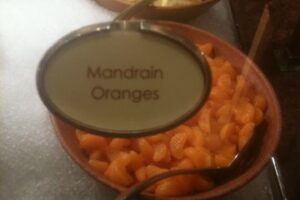
Mandarin oranges signYou don’t always need books to help your kid read better.
When my son and I go for a walk, there’s always something weird, funny or unintelligible to read, correct or figure out.

Example. We went on vacation and on the buffet we saw this sign. (Click on the picture for a larger image.) I called my son over and showed it to him – I didn’t say anything. He said, “hey,  that should be Mandarin!” And together, we showed the buffet lady and we all laughed about it.*

It was a great opportunity to get a bit playful with words, while at the same time showing my son the way to approach typos (and the people who make ‘em) - while it can be helpful to point out someone’s typo,  it’s not cool to be judgmental or become some kind of self-appointed ”grammar cop.”

Another time we were playing some miniature golf. As you go around the course, sometimes you have to wait for others to finish their hole. Rather than just wait, I would point to a sign and ask my son to rearrange the letters in the sign to form new words.

OK, it sounds nerdy, but it’s actually a pretty funny game because you wouldn’t believe some of the stuff kids come up with! There are no “rules” to the game – you can use all the letters, or just some of the letters – you can even add some letters if you see a phrase you’d like to create.Mini golf sign

The idea is just to take signs that you otherwise might not pay any attention to, and create new meaning from them

The next time you’re out with your kid, even if it’s just walking to school, take a look around you at all the reading possibilities. Every little bit helps.

*If you have a kid like mine, you’ll know immediately why a sign that says ”mandrain” is hilarious. Even the buffet lady thought that one was funny – and then she immediately removed the sign.

+Continue Reading

uKloo: the perfect literacy game for early readers

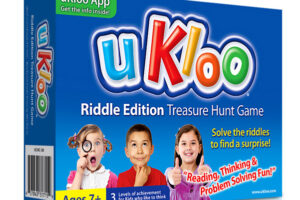
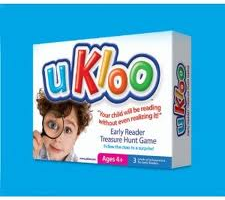
uKloo - fun literacy game for early readersThis could be the perfect literacy game.

So simple and so brilliant.

It has all the elements you could want in a game that encourages reading: it’s fun, it offers an immediate reward for reading, it’s easy for parents to quickly learn and set up and it has lots of “reading helpers” to make sure kids are successful.

uKloo will get your kids reading. It’s as simple as that.

uKloo (“you-clue”) is essentially a treasure-hunt game. You may even have done this yourself with your kids (I’ve recommended the idea – #6) but there’s no work for you to do, other than hiding the clues.

How to play

You hide cards around the house. The child picks the first card and reads, for instance, “look in your mom’s sock drawer.” When he gets there, he’ll find another card: “Look under the mat beside the bathtub.” Under the mat will be another card… and so on, until he gets to the “reward” card.

There are lots of wonderful things about UKLOO:

The “reward” is left up to you. If you believe in offering treats you can make the reward a Hershey’s kiss or some other candy. If your kid loves Lego, maybe he’ll find a Lego character at the end of his journey. Or a book. Or a loonie. Or a card that says, “good for one trip to gramma’s.” You can use whatever you feel will motivate your child, and whatever fits with your family’s values.

Children are set up for success. The game comes with a poster (which you stick up on the fridge or a nearby wall) that helps the child work through the words on the cards. Nouns, verbs and prepositions are listed with a picture to show the child, for instance, what “under” and “behind” mean. If the child can’t figure out a word, he can check the poster for help.

The game has three levels, depending on your child’s reading level. For instance:
Level 1: Look in your shoe.
Level 2: Check in the bathtub.
Level 3: Search behind the pillow on the couch.

As your child becomes a better reader, the game grows with him. Or, siblings can play alongside each other, using different levels.

uKloo was invented by Doreen Dotto, who was having trouble getting her kid to read. That was when he was in grade two. Today, the kid is an English major in university. Just sayin’.

uKloo sells in independent toy stores for $14.99 or on the company’s imperfect website, here. Now, Doreen, how about creating a version for older kids who are reading but still love to play fun reading games and find rewards in their shoes?

Here’s a video (1:18) of the game in action. (Spoiler alert: the kid finds the reward card.)


+Continue Reading

Great game: "No it wasn’t"

Here’s a great game that can spark an interest in plot and character. (And giggling and goofiness.)

By Jennifer A. Nielsen

A great road trip game is called “No, It Wasn’t.” It’s played with partners. One begins telling a story—any story. The other interrupts as often you like with, “No, it wasn’t”—or any grammatically-correct contradiction.

It may sound like this:
1: One morning, Jane went for a walk.
2: No, she didn’t.
1: That’s right. It wasn’t a walk. She was running. For exercise.
2: No, it wasn’t.
1: Actually, it was because someone was chasing her. A bad guy.
2: No, it wasn’t.
1: No, it was the police. Jane is the bad guy.

And so on. The challenge to the storyteller is to instantly change direction, as often as they’re prompted.

As the story continues, the predictable story lines usually fall away, and the requirement to make changes opens the doors to great creativity. A new story begins to emerge, one that goes in radical new directions. In the example with Jane above, it would’ve originally been a story about her going to visit her friends. In only three twists, Jane is on the run from the police.

Choose a main character, any main character, then give them something to do. And so your game begins.
Need a prompt?

Here it is: When (Main Character) came home that day an old friend was waiting.
No, it wasn’t.

Ed: Thanks, Jennifer – it is a great game. My son and I played it and we giggled like idiots the entire time. I found that the game worked best when the adult did the first story-telling, so the child could get the hang of it. All he had to say was, “No it wasn’t” and he could sort of see how things changed because of that. Then when it was his turn, he understood what needed to happen in his retelling. Thanks for letting us reprint this from the blog, Writing For Kids.

Jennifer A. Nielsen’s debut novel Elliot and the Goblin War was released in October 2010. And it comes with a warning–as of today, only seven children who have ever read this book have lived to tell about it. If you’re very brave, perhaps you’re willing to take your chance with it. The next book in the series, Elliot and the Pixie Plot will be released in May 2011.
(Ed: As soon as she’s able to send us a review copy, we’ll post a review about it. But I love the cover – look out, goblin! JG.)

+Continue Reading

Play on Words – literacy action game

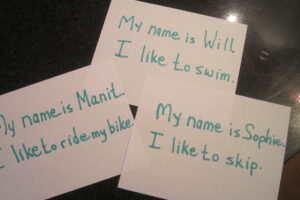
Cards for literacy activity

By Nancy Miller

Here’s a fun activity that can take five minutes, or roll out to 10 or 15.

The goal here is to have fun with words — and encourage your kid to get reading!

Play on Words
This activity uses three major learning styles:
• visual: they see the words.
• aural: they hear the words.
• kinesthetic: they act out the words

Here’s how to play:
1. Ask the child to say his name and what he likes to do. For instance:
“My name is Fraser. I like to swim.” (or ride my bike, or run, etc.)

2. Write down the answer in large letters.

3. Then together, pretend you’re swimming hard (lie across a chair and kick your feet while stroking with your arms; diving… make sure there’s lots of action!)

3. Read the words aloud, pointing to each word. Read the words together.

You can also extend the learning:
*Do the actions again. Then ask your child to pick out the words that go with that action.
*Keep a record of the words.
*Later you can also cut out pictures to go with the activities; this is excellent for reinforcement.

Variations
Other times, pretend:
*Animals; “My name is Fraser. I am a lion.”
*Vehicles: “My name is Fraser. I am a train.”
*Sports: “I like to play baseball.”

This will work with whatever your child’s interests are.

This activity is a shortened version of a longer learning-to-read program. If you would like more information on the program, please contact: Nancy Miller at millerneighbour@rogers.com.

+Continue Reading