Post Tagged with: "writing"

Writing contest for Canadian kids grades 4 to 12

Madonna with Writing Child, by Pinturicchio, 1490s.

Madonna with Writing Child, by Pinturicchio, 1490s.

If you’re a Canadian kid in grade 4 to 12, you could win a great prize in a writing contest sponsored by the Canadian Children’s Centre and TD.

Here are some details:

  • Deadline is Feb. 1, 2013;
  • Fiction or non-fiction stories or poems;
  • Entries must be mailed in (no emails or faxes);
  • Must include an entry form — found here;
  • Prizes: $250 book gift certificate for a winner in each grade plus two honourable mentions ($50) from each grade.

You’ll find more details, the address to send your entries to and the entry form on the Canadian Children’s Book Centre website, here.

(Oh, the image? Yeah, that’s a child in the 1400s. He’s writing. In a book held by the mother of Jesus. Don’t worry, he’s not eligible for the contest–not Canadian. Phew!)


+Continue Reading

Rory’s Story Cubes – simple, elegant literacy fun

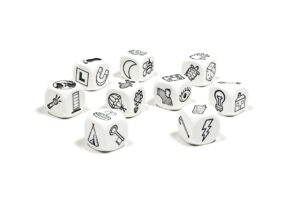
Rory Story CubesHere is a simple, elegant, wonderful game that’s great for:

• Story-building
• Fostering imagination
• Putting events in sequence
• Inspiration for writing a story
• Staving off boredom while you’re waiting at a restaurant
• General all-round silliness.

There are nine dice. Each one has six simple pictures. For instance, a happy face, a magic wand, a tree.

You use the nine images to build a story.

For instance:

I was happy when I found a magical tree.

or,

The magician used a tree to make his wand. It was a happiness wand.

or,

I “wand-ered” over to a tree, where I stopped and smiled at my own pun.

The great thing is that there are no wrong answers. And all kinds of possibilities.

Rorys Story Cubes box

Rory's Story Cubes come in a compact, efficient little magnetic box.

You can use as many or as few dice as you want. You can ignore some. You can make the images mean just what you want—even if that wouldn’t be someone else’s interpretation of the picture.

And you can get as silly as you want.

Rory’s Story Cubes are portable and stored in an elegant little magnetic-closure case. We bring them to restaurants and roll them while we’re waiting for the food to come.

Rorys Story Cubes app

The app sells for $1.99.

If you’ve got a few kids in your group—even if they’re very diverse in terms of age or interests—it’s a great way to keep them occupied. And laughing.

There’s a great back-story to this game. Rory originally invented his cube game for companies to foster creativity and teamwork. He has since come up with a number of different versions, including a version with just “action” pictures (verbs), one that’s about voyages, and a smart phone app.

Rory’s story cubes sell for about $15 and they’re available at most toy stores or online at the Rory’s Story Cubes website.

+Continue Reading

A book full of book bites

Breakfast On A Dragon'sTailIf you’re looking for an activity that will get your kid writing, Breakfast on a Dragon’s Tail, by Martin Springett, is a new and interesting concept book.

Dragon’s Tail gives you the beginning of a story, and your kid writes the rest.

There are 13 book bites in all, each one an intriguing start, whimsically illustrated, to a story that your child will finish.

Here’s my favourite:

Dracula and Son

“Wake up, son! It’s time to terrify the neighbourhood!”

Papa Drac stretched and yawned, flexing his long, white hands and testing his bright, white fangs with a handy fork.

Ping! They were solid and scary–ready for all the terrifying stuff he had planned for the surrounding countryside, the lonely farmhouses, and the craggy castles.

“Nah, I’m tired,” said Drac Junior. “I wanna sleep in.”Dracula And Son

“You’ve already slept in for nine months! It’s Hallowe’en–time to sharpen those pearly whites and to practise blood-curdling screeches, climbing down walls, and flapping about in a creepy way!”

It goes on, but you get the idea.

Dragon’s Tail would be great for homeschooling, for teachers and for parents with kids who are keen to write but need a bit of inspiration.

And best of all, kids can go to the book publisher’s website and upload the endings they’ve written for any of the stories. Fun!


+Continue Reading

Silent E

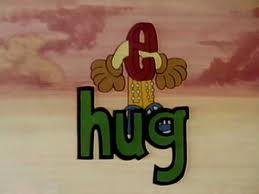
Here is a great video that teaches what Silent E does. (Spoiler alert: For one thing, it makes a hug huge!)

Thanks to thekidshouldseethis.com, who brought this to my attention via a tweet.
Their website is fantastic – it’s a collection of videos that kids just gotta see.

And if you’re in the mood for something slightly more modern…

+Continue Reading

Fun online spelling bee

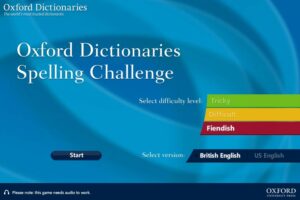
Oxford Spelling BeeThis one’s for kids who are already good spellers and who think spelling is fun. (To me it’s a no-brainer, but I have to remember that not everyone reads the dictionary for fun.)

Anyway, that kid will appreciate this great online spelling bee from Oxford. It’s fast and it’s fun – and it’s challenging.

Go to the Oxford Spelling Bee site.

Choose British English or US English. Then choose your level, from Tricky to Fiendish, and then click Start.

Warning – Fiendish will require you to spell words like gymkhana and belligerent, one of which I got wrong (Does the word not look better to you with one l? Look: beligerent. Oh. OK, that looks wrong.)

The website reads the word in a lovely British accent, so make sure your computer sound is turned well up. You can hear the word again if you want before you try to spell it. If you get it wrong, you get an X. If you get it right, you get a checkmark. Each category goes up to 15, and at the end you get your score.

I love that they start with “Tricky” as the lowest level which implies that if you get one wrong in that category, well, it was tricky. (It’s not you, it’s me, Oxford is saying.)

You can work your way through the levels, and you can do a level again to try to get a better score. When you do that, the words change so you can keep playing over and over again.

Now I’m feeling a bit belligerent about my score so I think I’ll go work out in my local gymkhana. Wait – with my horse. (I just looked it up.)

+Continue Reading

Advice from a young author: Dare to suck

Do you have a kid you’re trying to encourage to write more?

Is your kid discouraged because she’s worried that her writing isn’t good enough?

Here’s some great advice from a young author, Maureen Johnson, who is currently working on her 10th novel for teens.

She will tell your kid (in her own inimitable way) that in order to write well, first you need to suck. (3:56 but it goes fast.)

Here’s a link to Maureen’s website.

+Continue Reading

TDSB writing contest – win a laptop!

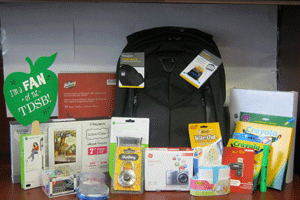
TDSB Prize pack for writing contest 2011.It’s time to get writing again – and here’s a wonderful incentive for kids in the Toronto District School Board (TDSB).

Write 150 to 250 words about what you’re most looking forward to this school year.

And you could win a Dell Inspiron Duo Laptop (value $550) or a backpack full of back-to-school stuff including a Kobo reader and a digital camera (value: $400).

Here’s the link to the contest where you’ll find all the details.

The contest is open to TDSB students, kindergarten to Grade 12. Four winners will be chosen (two elementary and two secondary). Winners will be judged on originality, style and overall impression.

Email your entry to communications@tdsb.on.ca before Friday, Sept. 16, 2011.
Include your full name, student ID number, grade and school.

So… get writing, and good luck!


+Continue Reading

How a pencil can help your child become a writer

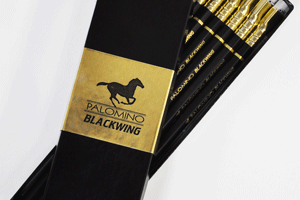
Palomino Blackwing pencils in a boxI have a theory that a really great pencil might get your kid to do more writing.

Now, hear me out. (And let me assure you right now this isn’t an ad and I’m not being paid by anyone.)

I’m not just talking about a pretty pencil. It’s not some “normal” pencil with a fancy topper. It’s not sparkly and it doesn’t write in three colours. I’m talking about a pencil that is so special, so outrageously beautiful to use that it makes you want to keep writing and never stop.

To understand the Blackwing Palomino you have to go back a few years, to the 1990s when Eberhard-Faber stopped making them. (Those original Blackwings have sold on eBay for up to $40 each.) The Blackwing came back last year, produced by Cal Cedar. They did extensive research to figure out how to reproduce, as closely as possible, the pencil that Eberhard-Faber used to make.

I purchased a box from pencils.com after reading this review on boingboing.net.

Now here’s my review… and the reason why the Blackwing is the only pencil I will ever use… and the reason I never let my Blackwings out of my sight… and the reason I think that giving one to your kid will actually help his schoolwork.

The first thing you’ll notice is the cool, white, square-topped flat eraser. It is armoured in a shiny golden ferrule. You can pull up the eraser to extend it as you use it – or you can replace it altogether. The pencil itself is matte black, accented with a band of gold just below the eraser.

Then there’s the feel of the pencil in your hand. It’s soft and smooth, almost warm to the touch. You want to caress its perfect octagonal sides. You do.

But the best thing about the Blackwing is the way it writes. As the graphite glides along the surface of your page it lays down a fine, soft, black trail. If you’ve ever written with a stick in hard moist sand on a fine beach, you’ll know something about how this feels. There is a satisfying friction as the lead glides over the page, tracking its lines along your paper.

It is a soft, warm, smooth writing experience. Easy to erase, and to write and to smudge. It is an artist’s experience, but it is just as much a writer’s experience, or a mathematician’s. Or a kid’s.

On pencils.com you can also buy one of the finest (cheap) pencil sharpeners you will ever use, and this I recommend for the Blackwing. It uses a two-step process; one hole cuts away the wood from the lead and the second one sharpens the lead itself. And there will be a great deal of sharpening with the Blackwing. The smooth, lazy writing experience comes at a price–you will have to sharpen often and well because the graphite is so soft.Two-holed pencil sharpener, called KUM

But it will be worth it.

A non-disclosure: I don’t work for Blackwing, nor did I get anything from pencils.com other than a box of Blackwing 602 pencils, which are not the ones I have reviewed above. (The 602 is also a superb pencil; it is grey matte with a black eraser. It lays down less graphite and doesn’t need as much sharpening and for that reason some people say that the Blackwing is for artists and the 602 is for writers. But I am a writer, and I heartily disagree. Take back my 602s and replace them with more Blackwings, I say.)

In a media release from Blackwing, I see that they’re coming out with a line of premium notebooks in September. If they’re one iota as satisfying as the Blackwings that are meant to write on them, I’ll be rushing to get one.

Palomino Blackwing 602

Palomino Blackwing 602


+Continue Reading

QR codes – reading fun for the whole (nerdy) family

QR code GKreadingOK, this is a great tip but it might be a bit… er… nerdy. But then, so am I. And so is my kid, who wears it like a badge of honour.

You’ve seen these QR codes, right? They’re on ads, posters, marketing material. Maybe you never knew what they were.

They’re like bar codes, but readable by anyone with a cellphone. You take an app like RedLaser (iPhone or Android) and scan the QR code, which reveals a hidden message, website, phone number, URL, etc.

So I was thinking it would make an excellent scavenger hunt to get kids reading.

You create some goofy, fun, positive or even utterly meaningless messages and print them out. Then you hide them around the house and give your kid your phone. Hilarity ensues. Well, maybe not hilarity – but certainly reading.

One scavenger hunt game could include messages like, “Look under the couch” and then the QR code hidden under the couch would read, “Look in your left shoe by the door,” and so on until the kid finds a new book on his pillow or something.

Or you could print one up and stick it in your kid’s lunchbox (his friend has a phone, you know he does). Now your kids kind of cool and you’re the cool mom who know about technology.

If you’ve never tried reading a QR code before, download the app and try this one I just made up:

qrcode

You can make up your own QR codes at Kaywa. Or even better, have your kid make some up.

The idea for this post came from this smart and funny blog I’ve been following for years, Ironic Sans (if you know your typography, the title is funny).

+Continue Reading

Five minutes to bridge the racial achievement gap

Choke by Sian BeilockI’ve been reading this book – Choke. (Because I tend to choke at tennis, that’s why.)

But it’s got some really interesting things to say that will help your kid with test anxiety.

Researchers were studying what happens to African-Americans, for instance, who experience racism throughout their life. These students can have something called “stereotype threat,” which is where students “underperform relative to their potential merely because these students feel discouraged about their ability to succeed.”

They may underperform simply because they are aware of stereotypes about their sex, race or ethnic group that pertain to intelligence.

Researchers wanted to see if they could intervene to subvert the “racial achievement gap” in a school in the Northeastern U.S.

What they did was simple, and brilliant – and it could be done with your child, whether or not he underperforms currently, whether or not he is a minority.

They had half the students respond to a question asking them what their most important value was, and write a brief paragraph explaining why it was important. In the second group – a control group – they had students write about their least important value.

At the end of the school year, they compared the kids. The ones who had – just once in the year, remember – taken the time to consider and think about, and write about, their most important value did better than the other students. The researchers later repeated the experiment, with the same results.

What happened? The students had written about qualities that were important to them. This enhanced their self-worth, even in the face of negative racial stereotypes. It created a “buffer against negative expectations and their consequences,” says the author of Choke, Sean Beilock.

Students who thought about their own good qualities, the things they value, did better at school because they reminded themselves that they could.

It seems that writing is key here. The kids have to take five minutes or so and write down their thoughts about their most important value. And not only did they perform better on that one test, in that one semester, but the research suggests there has been a life-long benefit for many of them.

If your kid says “I can’t do it,” help him remember that in fact, he can.

And by the way, just this afternoon I tried it before I got on the tennis court… 6-2, thank you very much!

+Continue Reading