Post Tagged with: "young readers"

Every child in grade one gets “I’ve Lost My Cat” by Philippe Beha

  • November 22, 2012 at 9:08 pm
  • Great books
  • Comments Off

IveLostMyCat_coverEvery year, all grade one students in Canada get a free book.

That’s every grade one student — more than 500,000 of them. No matter what school board they’re with, whether they’re homeschooled, whether they live in a remote community. Everyone gets a book to take home and read over and over again and keep.

The program is funded by TD Bank and it’s administered by the Canadian Children’s Book Centre. The CCBC selects wonderful books. Just the right books, in fact. And this year’s gem is no exception.

Author/Illustrator Philippe Beha’s little grey cat once went missing. He put up signs around the neighbourhood in hopes of getting him back. Several people called with cats – however, they were always the wrong ones.

Beha’s story folds into a brilliant and beautiful picture book, “I’ve Lost my Cat,” with charm and depth and sensitive wit. The half-million children in Canada who will be receiving Beha’s book will love it.

In the book, our protagonist is handed many animals – and even a melon – that fit some part of the description of his cat. He accepts them all graciously, finding a home for the elephant, the penguin, the bird and even the sheep he’s presented with. And just when he least expects it… he finds his cat. (Didn’t think you’d mind the spoiler.)

The book is “J’ai Perdu Mon Chat” in French.

Every child deserves to have a book of their own. Not only does owning a book promote literacy, but it promotes self-esteem. TD and the CCBC began their Grade One Book Giveaway Program in 2000. Since then they’ve given away millions of books.

It is a very, very good thing.

Visit the CCBC here, and get a list of the previous years’ books – you know they are sure-fire winners, every one.

+Continue Reading

My picture book, Gabby, launches January 2013

  • October 27, 2012 at 11:28 am
  • Great books
  • Comments Off

Gabby posterI’ve written a picture book called Gabby, which will be in bookstores this January.

You can also pre-order it on Amazon here.

Gabby is illustrated by the wonderful Jan Dolby and published by Fitzhenry & Whiteside.

Gabby is a smart, quirky little girl with a special reading book. When she accidentally drops it, all the letters fall out. When she starts putting the letters together into words, whatever she spells — she creates! As you can imagine, this gets her into quite a muddle. What can she do to put things right?

Visit my author blog for Gabby here. The author blog has lots of fun illustrations, colouring pages and information about Gabby.

+Continue Reading

Fun, active (and profitable!) literacy game

Dollar_sign_(reflective_metallic); from Wikimedia CommonsMy niece told me about a game that her friend’s mom used to set up to get her kids more interested in reading.

She would scatter letters around the room. Each letter had a price on it.

“Easier” letters like E might be worth a penny or five cents, whereas “harder” letters like Q or Z might be worth a quarter.

(Are you seeing where this is going?)

The kids would run around the room, collecting the letters; they would then put them together into words or phrases.

Then they’d add up the “money” they’d earned and… cash them in, using their parents as the bankers.

My niece said the game succeeded in making her friend much more interested in words and in reading.

And, presumably, in banking.

Here’s another case in which a mom successfully bribed her daughter into reading.

+Continue Reading

Stuffed letters are great for literacy

Letters for GabbyMy picture book, Gabby, is coming out this September.

I’m excited! The illustrations are by Jan Dolby and it’s published by Fitzhenry & Whiteside.

I’ll be doing some readings in schools, book stores and at Word On The Street to publicize the book.

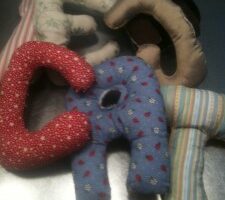
I sewed and stuffed some fabric letters to use during the readings. It occurred to me that letters like this are also great for new readers, since they can hold them and make words out of them. Making letters and words tactile for kids is a terrific way to get them reading.

There are lots of ways you can do this without making your own fabric letters (trust me, it’s a lot of work). You can use Scrabble tiles, foam letters from the dollar store, letter dice from a game like Jr. Boggle or Alphabet Scoop, or you can cut out letters or words from magazines.

+Continue Reading

The best Canadian picture books

Julie Booker is an author, a teacher, a librarian and last but not least, the mom of twin toddlers.

All this to say, she knows her picture books!

Her Canadian summer picture book reading list was recently published here on 49th Shelf, an awesome Canadian book website.

Below is her list of the best of the best. For her comments about each one, visit 49th Shelf.com. Click on their book links for more information about each book.

Drumheller Dinosaur Dance by Robert Heidbreder

Jelly Belly by Dennis Lee

M is for Moose by Charles Pachter

The Hockey Sweater by Roch Carrier

City Alphabet by Joanne Schwartz and Matt Beam

Eenie Meenie Manitoba by Robert Heidbreder

The Cremation of Sam McGee by Robert W. Service

Butterscotch Dreams by Sonja Dunn

My pick from here - If you're not Canadian and you've never read The Hockey Sweater by Roch Carrier, get your hands on a copy because you will fall in love with its folk-charm illustrations and true-life story about a boy who loves his Montreal Canadiens hockey team. (If you are Canadian? You've already read it.) Oh, and another way you know Julie Booker knows her books? Her last name, sha-zam!


+Continue Reading

An awesome way to remember “subject” and “predicate”

“Mr. Morton is the subject of the sentence and what the predicate says – he does!”

Thanks to Tina, via her FB page, for this.
+Continue Reading

Rory’s Story Cubes – simple, elegant literacy fun

Rory Story CubesHere is a simple, elegant, wonderful game that’s great for:

• Story-building
• Fostering imagination
• Putting events in sequence
• Inspiration for writing a story
• Staving off boredom while you’re waiting at a restaurant
• General all-round silliness.

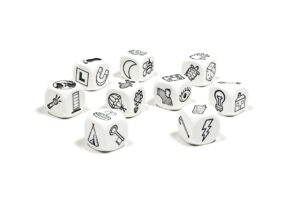
There are nine dice. Each one has six simple pictures. For instance, a happy face, a magic wand, a tree.

You use the nine images to build a story.

For instance:

I was happy when I found a magical tree.

or,

The magician used a tree to make his wand. It was a happiness wand.

or,

I “wand-ered” over to a tree, where I stopped and smiled at my own pun.

The great thing is that there are no wrong answers. And all kinds of possibilities.

Rorys Story Cubes box

Rory's Story Cubes come in a compact, efficient little magnetic box.

You can use as many or as few dice as you want. You can ignore some. You can make the images mean just what you want—even if that wouldn’t be someone else’s interpretation of the picture.

And you can get as silly as you want.

Rory’s Story Cubes are portable and stored in an elegant little magnetic-closure case. We bring them to restaurants and roll them while we’re waiting for the food to come.

Rorys Story Cubes app

The app sells for $1.99.

If you’ve got a few kids in your group—even if they’re very diverse in terms of age or interests—it’s a great way to keep them occupied. And laughing.

There’s a great back-story to this game. Rory originally invented his cube game for companies to foster creativity and teamwork. He has since come up with a number of different versions, including a version with just “action” pictures (verbs), one that’s about voyages, and a smart phone app.

Rory’s story cubes sell for about $15 and they’re available at most toy stores or online at the Rory’s Story Cubes website.

+Continue Reading

World Read-Aloud Day is Wed., March 7

wrad2012badgeIt’s very important to read to your child.

In fact, we consider it one of the top three most important things you can do to help your kid develop a love of reading.

Every day – but especially on Wed., March 7 – take the time to read to your child.

Or even someone else’s. Or a bunch of kids. There’s no downside – and a huge upside.

More information on WRAD here.

+Continue Reading

Why your kid needs a bookshelf

My bookshelfMy bookshelf and my books have been held captive in my attic for eight years.

Last week I hired a professional organizer. Long-story short, my bookshelf is now where it belongs – in my home-office, with all of my favourite books on it.

There’s the Pelican Shakespeare, with the tissue paper leaves; The Tragedies, The Comedies, The Histories and The Romances. This is the Shakespeare that I used to lie in bed with, cram for my mid-terms with, enjoy with a glass of white wine in the days before I was sophisticated enough for red wine.

Timothy Findley, himself, signed that copy of You Went Away. I stood in line, he signed it, I slammed it shut and I scurried away with my autographed copy, like a squirrel with a treasured nut. Later, I opened it to read my sage’s inscription at my leisure, and share it with my friend. To our amazement, and then hilarity, we could not decipher what on earth he had written. “Cordially free”? I looked at her. We peered at the handwriting again. Cordially free? For years, my girlfriend and I would happily greet each other with, “cordially free!” It was only yesterday that I opened it again, 17 years later, and there – clear as a bell - it says “with cordial feelings.”

There is the copy of Marshall McLuhan’s Counter-Blast. Inside the front cover is a plate: Awarded to Joyce Grant of Woburn Collegiate Institute for Outstanding Achievement in CREATIVE WRITING; Dated this 20th day of February, 1981. A fittingly formal kick-off to what will prove to be a lifelong career in writing (albeit, not every word of which will turn out to be either creative or outstanding).

The first-edition Gone With The Wind from my first husband — now himself, gone with the wind.

My Norton Anthologies, from which I’d proudly slogged through The Faerie Queene and Paradise Lost – until someone years later pointed out that both were “abridged,” and doused any hope I had of bragging that I’d read either of them all the way through.

Every book on my shelf tells a story.

I pass my fingers over the embossing on the covers. I open the older books and riffle the pages to smell the memories. The sight of my bookshelf, back where it belongs, by my side in the room where I write each day, almost makes me cry.

And that is why your kid needs a bookshelf of his own.


+Continue Reading

Picture is worth 1,000 words to a toddler

The Crown On Your Head, by Nancy Tillman

A beautiful illustration from The Crown On Your Head, by Nancy Tillman

To a pre-reader, words aren’t the main attraction.

As a parent, you can read the words to your child sometimes… and then other times, don’t be afraid to ignore the words.

You can go through an entire picture book with your toddler, pointing to the pictures and talking about them.

Identify the colours. Name some of the items in the picture. Ask her, “what do you see?” or “what’s that?” Let her point something out. (Make a big deal out of it when she does.)

Going through a picture book this way can also help to prevent some of the parent burnout that can come with reading the same picture book over and over with your child.

I recently came across a picture book whose pictures I absolutely adore… but I wasn’t that taken with the words.

It’s called The Crown On Your Head, by Nancy Tillman. It’s got a great premise, too – it talks about a “crown” each of us is born with, that we wear all our lives. The ”crown” signifies that we are important and special.

The book’s message about self-esteem and equality is lovely, and the illustrations are rich and luscious.

It’s a book parents could look at with a baby or a toddler and they wouldn’t necessarily even have to read the words. You could use the premise, point to the crowns on each page, and talk about how your child is special, too. And how we all have a crown, how each person is wearing one and it means that everyone can shine. So nice.

Thank you to Maile Carpenter for inspiring this blog post.

+Continue Reading